Showing posts with label Smell. Show all posts

Tuesday, March 15, 2016

151. Uncle Tungsten - IV. Chapters 8-9


Jump to Introduction & Chronology
Jump back to Previous: Uncle Tungsten - III. Chapters 5-7

Uncle Tungsten

Chapter 8. Stinks and Bangs

...
p79 Many of the so-called transition elements infused their compounds with characteristic colors... Sapphires, chemically, were basically nothing but corundum, a colorless aluminum oxide, but they could take on every color in the spectrum -- with a little bit of chromium replacing some of the aluminum, they would turn ruby red; with a little titanium, a deep blue; with ferrous iron, green; with ferric iron, yellow. And with a little vanadium, the corundum began to resemble alexandrite, alternating magically between red and green -- red in incandescent light, green in day light. With certain elements, at least, the merest smattering of atoms could produce a characteristic color... 

p80 There were only a handful of these "coloring" elements -- titanium, vanadium, chromium, manganese, iron, cobalt, nickel, and copper, so far as I could see, being the main ones. They were, I could not help noticing, all bunched together in terms of atomic weight -- though whether this meant anything, or was just a coincidence, I had no idea at the time. It was characteristic of all of these, I learned, that they had a number of possible valency states, unlike most other elements, which had only one. Sodium, for instance, would combine with chlorine in only one way, one atom of sodium to one of chlorine: an atom of iron could combine with two atoms of chlorine to form ferrous chloride (FeCl2) or with three atoms of chlorine to form ferric chloride (FeCl3). These two chlorides were very different in many ways, including color.

Because it had four strikingly different valencies or oxidation states, and it was easy to transform these into one another, vanadium was an ideal element to experiment with. The simplest way of reducing vanadium was to start with a test tube full of (pentavalent) ammonium vanadate in solution and add small lumps of zinc amalgam. The amalgam would immediately react, and the solution would turn from yellow to royal blue (the color of tetravalent vanadium). One could remove the amalgum at this point, or let it react further, till the solution turned green, the color of trivalent vanadium. If one waited still longer, the green would disappear and be replaced by a beautiful lilac, the color of divalent vanadium. The reverse experiment was even more beautiful, especially if one layered potassium permanganate, a deep purple layer, over the delicate lilac; this would be oxidized over a period of hours and form separate layers, one above the other, of lilac divalent vanadium on the bottom, then green trivalent vanadium, then blue tetravalent vanadium, then yellow pentavalent vanadium (and on top of this, a rich brown layer of the original permanganate, now brown because it was mixed with manganese dioxide).

p80 First mention of valency states... there's still hope. 


p81 These experiences with color convinced me that there was a very intimate (if unintelligible) relation between the atomic character of many elements and the color of their compounds or minerals... And from this I got a vague feeling... that the color of these metal ions, their chemical color, was related to the specific state of their atoms as they moved from one oxidation state to another. What was it about the transition elements, in particular, that gave them their characteristic colors? Were these substances, their atoms, in some way "tuned"? (Note: [Sacks refers back to an eighteenth century mathematician, Leonhard Euler, who also speculated about color]... 

The nature of radiation by which we see an opaque object does not depend on the source of light but on the vibratory motion of the very small particles {atoms} of the object's surface. These little particles are like stretched strings, tuned to a certain frequency, which vibrate in response to a similar vibration of the air even if no one plucks them. Just as the stretched string is excited by the same sound that it emits, the particles of the surface begin to vibrate in tune with the incident radiation and to emit their own waves in every direction. 


David Park, in The Fire Within the Eye: A Historical Essay on the Nature and Meaning of Light, writes of Euler's theory: 

I think this was the first time anyone who believed in atoms ever suggested that they have a vibrating internal structure. The atoms of Newton and Boyle are clusters of hard little balls, Euler's atoms are like musical instruments. His clairvoyant insight was rediscovered much later, and when it was, nobody remembered who had it first. 


Now, I think Euler was in fact completely wrong about color, but this sounds so much like a preview of String Theory, that my mind is blown. Of course, he was thinking about atoms or molecules really, while String Theory applies to the subatomic particles that -- to the amazement of anyone in the eighteenth century -- are the components of the supposedly indivisible atoms. As similar as the language sounds, I suspect if you could (perhaps call on Mephisto to) resurrect Euler and explain to him the current understanding of these topics, rather than claiming to be a precursor of String Theory, I suspect he would be depressed that he had it all so badly wrong.)

A lot of chemistry seemed to be about heat -- sometimes a demand for heat, sometimes the production of heat. Often one needed heat to start a reaction, but then it would go by itself, sometimes with a vengeance. If one simply mixed iron filings and sulfur, nothing happened -- one could still pull out the iron filings from the mixture with a magnet. But if one started to heat the mixture, it suddenly glowed, became incandescent, and something totally new -- iron sulfide -- was created. This seemed a basic, almost primordial reaction, and I imagined that it occurred on a vast scale in the earth, where molten iron and sulfur came into contact.
...
p83 I liked mixing iodine and zinc, or iodine and antimony -- no added heat was needed here -- and seeing how they heated up spontaneously, sending a cloud of purple iodine vapor above them. The reaction was more violent if one used aluminum rather than zinc or antimony. If I added two or three drops of water to the mixture, it would catch fire and burn with a violet flame, spreading fine brown iodine powder over everything.

Magnesium, like aluminum, was a metal whose paradoxes intrigued me: strong and stable enough in its massive form to be used in airplane and bridge construction, but almost terrifyingly active once oxidation, combustion, got started. One could put magnesium in cold water, and nothing would happen. If one put in in hot water, it would start to bubble hydrogen: but if one lit a length of magnesium ribbon, it would continue to burn with dazzling brilliance under the water, or even in normally flame-suffocating carbon dioxide... if one heated magnesium with sand, silicon dioxide -- and what could be more inert than sand? -- the magnesium would burn brilliantly, pulling the oxygen out of the sand, producing elemental silicon or a mixture of silicon with magnesium silicide... If one then tipped the silicide into dilute hydrochloric acid, it would react to form a spontaneously inflammable gas, hydrogen silicide, or silane -- bubbles of this would rise through the solution, forming smoke rings, and ignite with little explosions as they reached the surface.
...
p84 With chemistry such as this, one was playing with fire, in the literal as well as the metaphoric sense. Huge energies, plutonic forces, were being unleashed, and I had a thrilling but precarious sense of being in control -- sometimes just. This was especially the case with the intensely exothermic reactions of aluminum and magnesium; they could be used to reduce metallic ores, or even to produce elemental silicon from sand, but a little carelessness, a miscalculation, and one had a bomb on one's hands.
...
p85 Some things he mentions here that I was having a problem envisioning. Here's a gutta percha (=natural rubber) bottle. 
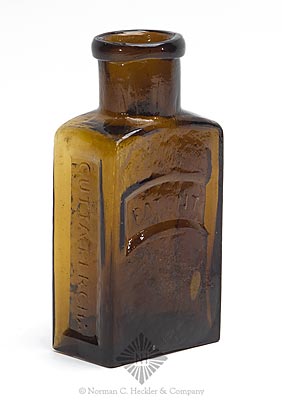


A "carboy" is a large container, like the bottle for a water-cooler.


I'm really hoping he's going to talk about the physics of chemistry, since that's the part that interests me. 


p86 ...What gave coffee its aroma? What were the essential substances in cloves, apples, roses? What gave onions and garlic and radishes their pungent smell? What, for that matter, gave rubber its peculiar odor? I especially liked the smell of hot rubber, which seemed to me to have a slightly human smell (both rubber and people, I learned later, contain odoriferous isoprene). Why did butter and milk acquire sour smells when they "went off," as they tended to do in hot weather? What gave "turps," oil of turpentine, its lovely, piney smell? ...
...
p87 ...the scent of pears, I had read, could be made artificially... One had only to start with one of the alcohols -- ethyl, methyl, amyl, whatever -- and distill it with acetic acid to form the corresponding ester. I was amazed that something as simple as ethyl acetate could be responsible for the complex, delicious smell of pears, and that tiny chemical changes could transform this to other fruity scents -- change the ethyl to isoamyl, and one had the smell of ripening apples; other small modifications would give esters that smelled of bananas or apricots or pineapples or grapes. This was my first experience of the power of chemical synthesis.
...
p88 My interest in smells made me wonder how we recognized and categorized odors, how the nose could instantly delineate esters from aldehydes, or recognize a category such as terpenes, as it were, at a glance... there... seemed in humans to be a chemical analyser at work at least as sophisticated as the eye or the ear. There did not seem to be any simple order, like the scale of musical tones, or the colors of the spectrum; yet the nose was quite remarkable in making categorizations that corresponded, in some way, to the basic structure of the chemical molecules. All the halogens, while different, had halogenlike smells... Most esters were fruity; alcohols -- the simplest ones, anyway -- had similar "alcoholic" smells; and aldehydes and ketones, too, had their own characteristic smells.

p89 (Errors, surprises, could certainly occur, and Uncle Dave told me how phosgene, carbonyl chloride, the terrible poison gas used in the First World War, instead of signaling its danger by a halogenlike smell, had a deceptive scent like new-mown hay. This sweet, rustic smell, redolent of the hayfields of their boyhood, was the last sensation phosgene-gassed soldiers had just before they died.)

The bad smells, the stenches, always seemed to come from compounds containing sulfur (the smells of garlic and onion were simple organic sulfides, as closely related chemically as they were botanically), and these reached their climax in the sulfyuretted alcohols, the mercaptans. The smell of skunks was due to butyl mercaptan, I read...

Thinking of all the malodorous sulfur compounds and the atrocious smell of selenium and tellurium compounds, I decided that these three elements formed an olfactory as well as a chemical category, and thought of them thereafter as the "stinkogens."
...
Hydrogen selenide, I decided, was perhaps the worst smell in the world. But hydrogen telluride came close, was also a smell from hell...

This is so frustrating. He talks about the chemical origins of smells but doesn't go the next step and talk about the -- let's call it "valence" -- reason for this. He doesn't even explain the similarity of scents: Why do ripening apples smell like isoamyl acetate? Is that chemical or something similar present in the apples?

I'm glad that he seconds my observation that the sense of smell is a precise chemical process. But what's behind this at the level of physics. And how do our brains perform this chemistry? 


Chapter 9 Housecalls

...
p93 ...He [Oliver's doctor father] loved doing housecalls more than anything else, for they were social and sociable as well as medical, would allow him to enter a family and home, get to know everybody and their circumstances, see the whole-complexion and context of a condition. Medicine, for him, was never just diagnosing a disease, but had to be seen and understood in the context of patients' lives, the particularities of their personalities, their feelings, their reactions.
...
Driving through the City, deserted on a Sunday, was a sobering experience in 1946, for the devastation wrought by the bombing was still fresh, and there had been little rebuilding as yet. This was even more evident in the East End, where a fifth of the buildings, perhaps, had been leveled. But there was still a strong Jewish community there, and restaurants and delicatessens like no where in the world. My father... had been the Yiddish-speaking doctor of the Yiddish-speaking community around... [the London Hospital in Whitechapel Road] for ten years...

I've copied this passage for two reasons; first the better practice of medicine in those simpler times; but also because there's an interesting story to the greater destruction on the East Side of London during the war. From this passage, it isn't possible to tell how much of the destruction was from the literal bombing by the Luftwaffe, and how much was the result of the V-1 and V-2 programs at the very end of the war. I have a feeling I've told this story before, but it's an interesting ethical tale so I'm going to tell it again.

MI5 had control of virtually all the German agents in Britain toward the end of WW2, so MI5 decided what reports went back to Germany. At the time of the Vengeance attacks, it was judged that the best they could do to undermine the German plan was to miss-report the landing sites of the flying or ballistic bombs so as to throw off the aim of the entire operation. The only way for this to work was to make the East End, instead of the center of London, the actual target. This worked splendidly with many bombs landing way to the east and few actually hitting the center of London -- but the East End suffered and the government continued to keep this all a secret until long after the war was over.

In the terms of The Righteous Mind discussion of morality, this was the equivalent of pushing an innocent bystander onto the tracks to stop the trolley and save more people. 


There are a couple additional things in this chapter that I'm not going to copy out but do what to comment on. Sacks describes his father as a great mimic, he could mimic the "festination" of a mentor doctor, but also asthma, convulsions, and paralysis. And he speculates that this made him sensitive to the situation of his patients. I would also suspect that this was an excellent way to remember and notice certain symptoms -- using body memory as it were. 

The second thing has to do with his father's brother, Bennie, who had been excommunicated from the family and never mentioned after marrying a gentile in Portugal. It wasn't until after his father's death that Oliver Sacks learned that the "fat farm" his father had been attending yearly without any success had actually been visits to his brother Bennie.

On the one hand, of course, this seems absurd. But having just read The Righteous Mind, I can also see the importance of this in preserving Jewish culture. I've skipped most of what Sacks has written to stress the importance of Judaism in his family. I don't see it as relevant to most of the topics here that interest me. But, it was essential in preserving the culture -- including intellectual and entrepreneurial culture -- which the Jewish people came to represent in the history of Europe in the past 500 and more years. 


Jump to Next: Uncle Tungsten - V. Boyle & Lavoisier

Tuesday, January 13, 2015

3. Doctor Faustus - chapter IX + Smell & Music

Jump to Introduction + Chronology

Jump back to Previous: Doctor Faustus - chapters VII-VIII


p70 ...But why do I ascribe such significance to them [these lectures]?... It is simply this: that Adrian heard these things then, they challenged his intelligence, made their deposit in the vessel of his feelings. and gave matter to feed or to stimulate his fancy... The reader must perforce be made a witness of the process; since no biography, no depiction of the growth and development of an intellectual life, could properly be written without taking its subject back to the pupil stage, to the period of his beginnings in life and art, when he listened, learned, divined, gazed and ranged now afar, now close at hand. As for music in particular, what I want and strive to do is to make the reader see it as Adrian did; to bring him in touch with music, precisely as it happened to my departed friend. And to that end everything his teacher said seems to me not only not a negligible means but even an indispensable one.


Suddenly this is reminding me of the preface to The Private Papers of Henry Ryecroft. We are getting exposition on the hero from a narrator standing between the author and the fictional subject of the work.


And so, half jestingly, I would address those who in that last monstrous chapter have been guilty of some skipping: I would remind them of how Laurence Sterne once dealt with an imaginary listener who betrayed that she had not always been paying attention. The author sent her back to an earlier chapter to fill in the gaps in her knowledge. After having informed herself, the lady rejoins the group of listeners and is given a hearty welcome.


I believe that would be a reference to The Life and Opinions of Tristram Shandy, Gentleman, though I had forgotten the passage. Yes, it is.


p71 The passage came to my mind because Adrian as a top-form student, at a time when he had already left for the University of Giessen, studied English outside the school courses, and after all outside the humanistic curriculum, under the influence of Wendell Kretschmar. He read Sterne with great pleasure. Even more enthusiastically he read Shakespeare, of whom the organist was a close student and passionate admirer... He [Kretschmar] opened to him the ample page of world literature; whetting his appetite by small foretastes, he lured him into the broad expanses of the Russian, English, and French novel; stimulating him to read the lyrical poems of Shelley and Keats, Holderlin and Novalis; gave him Manzoni and Goethe, Schopenhauer and Meister Eckhart... Obviously he had too little sleep, for his reading was done in the night hours. I did not refrain from confessing my concern to Kretschmar and asking him if he did not see in Adrian, as I did, a nature that in the intellectual field should be rather held back than urged forwards. But the musician, although so much older than I, proved to be a thoroughgoing partisan of impatient youth avid of knowledge, unsparing of his strength. Indeed, the man showed in general a certain ideal harshness and indifference to the body and its “health,” which he considered a right philistine, not to say cowardly value.


“Yes, my friend,” said he... “if it is healthiness you are after -- well, with mind and art it has not much to do, it even in a sort of way opposes them, and anyhow they have never troubled much about each other... And besides, I find nothing more tactless and barbarous than nailing a gifted youth down to his ‘immaturity’ and telling him in every other word: ‘That is nothing for you yet.’ Let him judge for himself!...”


And so we have, again, the relationship between health on the one hand and thought and art (matters of the intellect) on the other.


p74 ...”The chord as such is no harmonic narcotic but polyphony in itself [this is Adrian speaking], and the notes that form it are parts. But I assert they are more, and the polyphonic character of chords is the more pronounced, the more dissonant it is. The degree of dissonance is the measure of its polyphonic value. The more discordant a chord is, the more notes it contains contrasting and conflicting with each other, the more polyphonic it is, and the more markedly every single note bears the stamp of the part already in the simultaneous sound-combination.”


p76 “Bach’s problem,” he [Adrian] said, “was this: how is one to write pregnant polyphony in a harmonic style? With the moderns the question presents itself somewhat differently. Rather it is: how is one to write a harmonic style that has the appearance of polyphony? Remarkable, it looks like bad conscience -- the bad conscience of homophonic music in face of polyphony.”


p77 [after a passage about the German lied ...But Schubert’s always twilit genius, death-touched, he liked above all to seek where he lifts to the loftiest expression a certain only half-defined but inescapable destiny of solitude, as in the grandly self-tormenting “Ich komme vom Gebirge her” [“I come from rocky mountains steep”] from the Smith of Lubeck and that “Was vermeid’ ich denn die Wege, wo die andern Wandrer gehn” [“Why do I avoid the highways/That other wanderers travel”] from the Winterreise, with the perfectly heart-breaking stanza beginning:


Hab’ ja doch nichts begangen
Dass ich Menschen sollte scheu’n.


[I have truly done no wrong
That I should shun mankind]


These words, and the following:


Welch ein torichtes Verlangen
Treibt mich in die Wustenei’n


[What foolish desire
Drives me into the wastelands?]


I have heard him speak to himself, indicating the musical phrasing, and to my unforgettable amazement I saw the tears spring to his eyes.


Apparently our translator (H. T. Lowe-Porter) either thought these lyrics were so unimportant that they were not worth the trouble of translating; or that we, reading this German book in English, still knew enough German to translate these ourselves. Un-boh-lievable! (CommunityChannel reference.)


p78 [Adrian on the Overture in C of Fidelio ] “...Tell me, what do you think about greatness? I find there is something uncomfortable about facing it eye to eye, it is a test of courage -- can one really look it in the eye? ... I incline more and more to the admission that there is something very odd indeed about this music... A manifestation of the highest energy -- not at all abstract, but without an object, energy in a void, in pure ether -- where else in the universe does such a thing appear? We Germans have taken over from philosophy the expression ‘in itself,’ we use it every day without much idea of the metaphysical. But here you have it, such music is energy itself, yet not as idea, rather as its actuality. I call your attention to the fact that that is almost the definition of God. Imitatio Dei [ “imitating God”. The religious concept of finding virtue by imitating God.] -- I am surprised that it is not forbidden. Perhaps it is. Anyhow that is a very nice point -- in more than one sense of the word. Look: the most powerful, most varied, most dramatic succession of events and activities, but only in time, consisting only of time articulated, filled up, organized -- and all at once almost thrust into the concrete exigencies of the plot by the repeated trumpet-signals from without...”


Does Immanuel Kant address music? I cant recall. I would agree that while we really know nothing of the thing in itself in general, when it comes to music there can really be no doubt. One can debate the underlying reality of a cat, but not of Beethovens Ode to Joy. Of course, this is a point Nietzsche was all over in The Birth of Tragedy -- the sensory primacy of music. Music speaks to us more directly than anything else -- though I suppose you could make an argument for pheromones and other things that address our body beneath the software of our minds. Our minds may doubt the reality underlying these attractions, but there is no doubting the attraction itself. I Lust therefore I Am is, if you think about it, a better proof both of our existence and of the existence of something besides ourselves. It thwarts solipsism in a way Descartes (spits) popular phrase does not.


Smell
I’m also re-reading one of my favorite books,  A Natural History of the Senses by Diane Ackerman and ran into an interesting idea in the very first chapter, on smell, “Smell is the mute sense, the one without words.” She even picks the same example of this that I would have chosen, the experience of being in a citrus grove in spring. The effect is overwhelming and glorious but how would you describe either the scent itself or the effect it has on you?


But isn’t music also mute in this sense? How would you describe the experience of hearing Beethoven’s Ode to Joy, for example? Could you describe the music in any way except with reference to other music? And your description of the effect hearing this music has on you would be as inarticulate as the description of the citrus orchard. (I should perhaps admit here that I'm essentially blind to the tone poem... music does not make me "see" a painting or landscape. I may enjoy the music, as music, but I cannot make the connection to a visual realm).


I am reminded here of Foucault and Bataille (and their fellow travelers) and their attempts to experience and communicate that which is beyond words. The experience of both hearing music and smelling particular odors are profound, immediate, and unmistakable. Here’s Ackerman again, “Unlike the other senses, smell needs no interpreter. The effect is immediate and undiluted by language, thought, or translation. A smell can be overwhelmingly nostalgic because it triggers powerful images and emotions before we have time to edit them... ” That I salivate when I smell garlic, is undoubtedly a learned, conditioned, response. But the experience of sensing those particular chemicals in the air, for that has to be the foundation of odor, is innate.  When we smell we distinguish molecules floating in the air around us. If we were to develop a descriptive language for smells it would have to be with reference to elements and chemical compounds. We would be learning to do chemistry with our noses.


In the tenth century, in Japan, a glitteringly talented court lady, Lady Murasaki Shikibu, wrote the first real novel, The Tale of Genji, a love story woven into a vast historical and social tapestry, the cast of which included perfumer-alchemists, who concoct scents based on an individual’s aura and destiny. ” So my insight into smell as chemistry isn’t exactly groundbreaking. I know I’ve heard The Tale of Genji mentioned as the first novel, but how appropriate -- but not at all surprising -- that it was a woman who first began producing these little Creations. So gluttonous are we for story that even the endless variety of stories in Devi’s Dream (our reality) is insufficient so we must, in our turn, dream still more stories. If you’re asking about the “meaning of life” one obvious answer would be the creation of story. To view God as a novelist clears up many problems -- the problem of evil, for one.


But I’m wandering away from smell and music. Here Ackerman quotes a perfumer talking about creating a new scent:


“You always have an image in your head. You can actually smell the accords, which are like musical chords. Perfumery is closely related to music. You will have simple fragrances, simple accords made from two or three items, and it will be like a two- or three-piece band. And then you have a multiple accord put together, and it becomes a big modern orchestra. In a strange way, creating a fragrance is similar to composing music, because there is also a similarity in finding the ‘proper’ accords. You don’t want anything being overpowering. You want it to be harmonious. One of the most important parts of putting a creation together is harmony. You could have layers of notes coming through the fragrance, yet you still feel it's pleasing. If the fragrance is not layered properly, you’ll have parts and pieces sticking out, it will make you uncomfortable, something will disturb you about it. A fragrance that is not well balanced is not well accepted...”


...”when I first saw Picasso’s Guernica, it was disturbing. I was horrified and fascinated at the same time. It was disturbing, but also deeply moving. Perfumes do that, too -- shock and fascinate us. They disturb us. Our lives are quiet. We like to be disturbed by delight...”


In those last sentences I see the need both for dissonance and for story. Given the nature of this book, I have to include one last quote from the perfumer above, even though it would fit even better in chapter XIX,


“...I  would like to make a perfume some day so seductive to men that no woman could be resisted. It would be the most incredible thing I could do in my life. This is not a professional feeling. It’s strictly a female thing.”


[Ackerman] “The whole world would become unsafe.”


“Yes!” she says with relish.


Music
Ackerman also writes about music in her section on Hearing:

p219 For a long time, western music was homophonic, or “same voiced,” which doesn’t mean that only one person sang at a time but rather that there was one melody line or voice, and the rest of the music was harmony supporting it. Usually the main melody was the highest pitched, and identified the piece. Plainsong, the religious music of the fourth century, required no musical accompaniment at all; one voice sang the simple melody in Latin words. In the sixth century, Pope Gregory I decided to govern music making; as a result, the Gregorian chant evolved, which was sung in unison. In the Middle Ages, people made the extraordinary discovery that many tones could be made at once without cancelling one another out or resulting in mere noise, and polyphony was born. It seems impossible that it could have taken so long to reach that now-obvious conclusion. But music is not like vision. If you mix blue and yellow together, you lose the individual colors and make a new one; tones, on the other hand, may be combined without losing their individuality. What you end up with is a chord, something new, which has its own sound but in which the individual tones are also distinct and identifiable. It’s not a blending or. as one might expect when one hears a number of people talking at once, just noise, but something of a different order. A chord “is something like an idea,” philosopher of music Victor Zuckerkandl [follow the link!] writes, “an idea to be heard, an idea for the ear, an audible idea.” For colors to stay separate without blending, they have to occupy space next to one another. They can’t occupy the same space. But notes can occupy the same space and remain separate. As Zucherkandl reminds us, polyphony “coincided with the building of the great Gothic cathedrals, and the birth of harmony with the culmination of the Renaissance and the beginning of modern science and mathematics: that is, the two great changes in our understanding of space.” This may seem an odd observation, given the fact that vision is a spatial art, and music a temporal one, which “unfolds in time,” a dynamic art that uses many devices, including syncopation, in which notes appear like hobgoblins where you don’t expect them, and vanish just as startlingly; or like repetition, which snatches us back to an earlier pattern or flings us forward as if on the crest of a wave. “Music is not just in time,” Zuckerkandl writes. “It does something with time. . . . It is as if the even flow of time were cut up by the regularly recurrent sounds into short stretches of equal duration: the tones mark time.” They stain time, then they reassemble it into small groups like so many lengths of cloth that have been dyed separately. At least our western music does; we’re used to measured time in music. When polyphony came in, the only way it could make sense was if each of the voices kept the same time. But if we look back about 1,500 years or so, we find unmeasured time in music. A Gregorian chant, like poetry, simply improvised time...

Jump to Next: Doctor Faustus - chapters X