Showing posts with label Vanadium. Show all posts

Tuesday, March 15, 2016

151. Uncle Tungsten - IV. Chapters 8-9


Jump to Introduction & Chronology
Jump back to Previous: Uncle Tungsten - III. Chapters 5-7

Uncle Tungsten

Chapter 8. Stinks and Bangs

...
p79 Many of the so-called transition elements infused their compounds with characteristic colors... Sapphires, chemically, were basically nothing but corundum, a colorless aluminum oxide, but they could take on every color in the spectrum -- with a little bit of chromium replacing some of the aluminum, they would turn ruby red; with a little titanium, a deep blue; with ferrous iron, green; with ferric iron, yellow. And with a little vanadium, the corundum began to resemble alexandrite, alternating magically between red and green -- red in incandescent light, green in day light. With certain elements, at least, the merest smattering of atoms could produce a characteristic color... 

p80 There were only a handful of these "coloring" elements -- titanium, vanadium, chromium, manganese, iron, cobalt, nickel, and copper, so far as I could see, being the main ones. They were, I could not help noticing, all bunched together in terms of atomic weight -- though whether this meant anything, or was just a coincidence, I had no idea at the time. It was characteristic of all of these, I learned, that they had a number of possible valency states, unlike most other elements, which had only one. Sodium, for instance, would combine with chlorine in only one way, one atom of sodium to one of chlorine: an atom of iron could combine with two atoms of chlorine to form ferrous chloride (FeCl2) or with three atoms of chlorine to form ferric chloride (FeCl3). These two chlorides were very different in many ways, including color.

Because it had four strikingly different valencies or oxidation states, and it was easy to transform these into one another, vanadium was an ideal element to experiment with. The simplest way of reducing vanadium was to start with a test tube full of (pentavalent) ammonium vanadate in solution and add small lumps of zinc amalgam. The amalgam would immediately react, and the solution would turn from yellow to royal blue (the color of tetravalent vanadium). One could remove the amalgum at this point, or let it react further, till the solution turned green, the color of trivalent vanadium. If one waited still longer, the green would disappear and be replaced by a beautiful lilac, the color of divalent vanadium. The reverse experiment was even more beautiful, especially if one layered potassium permanganate, a deep purple layer, over the delicate lilac; this would be oxidized over a period of hours and form separate layers, one above the other, of lilac divalent vanadium on the bottom, then green trivalent vanadium, then blue tetravalent vanadium, then yellow pentavalent vanadium (and on top of this, a rich brown layer of the original permanganate, now brown because it was mixed with manganese dioxide).

p80 First mention of valency states... there's still hope. 


p81 These experiences with color convinced me that there was a very intimate (if unintelligible) relation between the atomic character of many elements and the color of their compounds or minerals... And from this I got a vague feeling... that the color of these metal ions, their chemical color, was related to the specific state of their atoms as they moved from one oxidation state to another. What was it about the transition elements, in particular, that gave them their characteristic colors? Were these substances, their atoms, in some way "tuned"? (Note: [Sacks refers back to an eighteenth century mathematician, Leonhard Euler, who also speculated about color]... 

The nature of radiation by which we see an opaque object does not depend on the source of light but on the vibratory motion of the very small particles {atoms} of the object's surface. These little particles are like stretched strings, tuned to a certain frequency, which vibrate in response to a similar vibration of the air even if no one plucks them. Just as the stretched string is excited by the same sound that it emits, the particles of the surface begin to vibrate in tune with the incident radiation and to emit their own waves in every direction. 


David Park, in The Fire Within the Eye: A Historical Essay on the Nature and Meaning of Light, writes of Euler's theory: 

I think this was the first time anyone who believed in atoms ever suggested that they have a vibrating internal structure. The atoms of Newton and Boyle are clusters of hard little balls, Euler's atoms are like musical instruments. His clairvoyant insight was rediscovered much later, and when it was, nobody remembered who had it first. 


Now, I think Euler was in fact completely wrong about color, but this sounds so much like a preview of String Theory, that my mind is blown. Of course, he was thinking about atoms or molecules really, while String Theory applies to the subatomic particles that -- to the amazement of anyone in the eighteenth century -- are the components of the supposedly indivisible atoms. As similar as the language sounds, I suspect if you could (perhaps call on Mephisto to) resurrect Euler and explain to him the current understanding of these topics, rather than claiming to be a precursor of String Theory, I suspect he would be depressed that he had it all so badly wrong.)

A lot of chemistry seemed to be about heat -- sometimes a demand for heat, sometimes the production of heat. Often one needed heat to start a reaction, but then it would go by itself, sometimes with a vengeance. If one simply mixed iron filings and sulfur, nothing happened -- one could still pull out the iron filings from the mixture with a magnet. But if one started to heat the mixture, it suddenly glowed, became incandescent, and something totally new -- iron sulfide -- was created. This seemed a basic, almost primordial reaction, and I imagined that it occurred on a vast scale in the earth, where molten iron and sulfur came into contact.
...
p83 I liked mixing iodine and zinc, or iodine and antimony -- no added heat was needed here -- and seeing how they heated up spontaneously, sending a cloud of purple iodine vapor above them. The reaction was more violent if one used aluminum rather than zinc or antimony. If I added two or three drops of water to the mixture, it would catch fire and burn with a violet flame, spreading fine brown iodine powder over everything.

Magnesium, like aluminum, was a metal whose paradoxes intrigued me: strong and stable enough in its massive form to be used in airplane and bridge construction, but almost terrifyingly active once oxidation, combustion, got started. One could put magnesium in cold water, and nothing would happen. If one put in in hot water, it would start to bubble hydrogen: but if one lit a length of magnesium ribbon, it would continue to burn with dazzling brilliance under the water, or even in normally flame-suffocating carbon dioxide... if one heated magnesium with sand, silicon dioxide -- and what could be more inert than sand? -- the magnesium would burn brilliantly, pulling the oxygen out of the sand, producing elemental silicon or a mixture of silicon with magnesium silicide... If one then tipped the silicide into dilute hydrochloric acid, it would react to form a spontaneously inflammable gas, hydrogen silicide, or silane -- bubbles of this would rise through the solution, forming smoke rings, and ignite with little explosions as they reached the surface.
...
p84 With chemistry such as this, one was playing with fire, in the literal as well as the metaphoric sense. Huge energies, plutonic forces, were being unleashed, and I had a thrilling but precarious sense of being in control -- sometimes just. This was especially the case with the intensely exothermic reactions of aluminum and magnesium; they could be used to reduce metallic ores, or even to produce elemental silicon from sand, but a little carelessness, a miscalculation, and one had a bomb on one's hands.
...
p85 Some things he mentions here that I was having a problem envisioning. Here's a gutta percha (=natural rubber) bottle. 
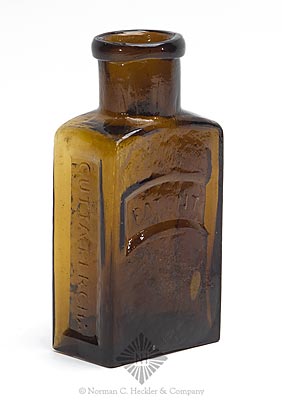


A "carboy" is a large container, like the bottle for a water-cooler.


I'm really hoping he's going to talk about the physics of chemistry, since that's the part that interests me. 


p86 ...What gave coffee its aroma? What were the essential substances in cloves, apples, roses? What gave onions and garlic and radishes their pungent smell? What, for that matter, gave rubber its peculiar odor? I especially liked the smell of hot rubber, which seemed to me to have a slightly human smell (both rubber and people, I learned later, contain odoriferous isoprene). Why did butter and milk acquire sour smells when they "went off," as they tended to do in hot weather? What gave "turps," oil of turpentine, its lovely, piney smell? ...
...
p87 ...the scent of pears, I had read, could be made artificially... One had only to start with one of the alcohols -- ethyl, methyl, amyl, whatever -- and distill it with acetic acid to form the corresponding ester. I was amazed that something as simple as ethyl acetate could be responsible for the complex, delicious smell of pears, and that tiny chemical changes could transform this to other fruity scents -- change the ethyl to isoamyl, and one had the smell of ripening apples; other small modifications would give esters that smelled of bananas or apricots or pineapples or grapes. This was my first experience of the power of chemical synthesis.
...
p88 My interest in smells made me wonder how we recognized and categorized odors, how the nose could instantly delineate esters from aldehydes, or recognize a category such as terpenes, as it were, at a glance... there... seemed in humans to be a chemical analyser at work at least as sophisticated as the eye or the ear. There did not seem to be any simple order, like the scale of musical tones, or the colors of the spectrum; yet the nose was quite remarkable in making categorizations that corresponded, in some way, to the basic structure of the chemical molecules. All the halogens, while different, had halogenlike smells... Most esters were fruity; alcohols -- the simplest ones, anyway -- had similar "alcoholic" smells; and aldehydes and ketones, too, had their own characteristic smells.

p89 (Errors, surprises, could certainly occur, and Uncle Dave told me how phosgene, carbonyl chloride, the terrible poison gas used in the First World War, instead of signaling its danger by a halogenlike smell, had a deceptive scent like new-mown hay. This sweet, rustic smell, redolent of the hayfields of their boyhood, was the last sensation phosgene-gassed soldiers had just before they died.)

The bad smells, the stenches, always seemed to come from compounds containing sulfur (the smells of garlic and onion were simple organic sulfides, as closely related chemically as they were botanically), and these reached their climax in the sulfyuretted alcohols, the mercaptans. The smell of skunks was due to butyl mercaptan, I read...

Thinking of all the malodorous sulfur compounds and the atrocious smell of selenium and tellurium compounds, I decided that these three elements formed an olfactory as well as a chemical category, and thought of them thereafter as the "stinkogens."
...
Hydrogen selenide, I decided, was perhaps the worst smell in the world. But hydrogen telluride came close, was also a smell from hell...

This is so frustrating. He talks about the chemical origins of smells but doesn't go the next step and talk about the -- let's call it "valence" -- reason for this. He doesn't even explain the similarity of scents: Why do ripening apples smell like isoamyl acetate? Is that chemical or something similar present in the apples?

I'm glad that he seconds my observation that the sense of smell is a precise chemical process. But what's behind this at the level of physics. And how do our brains perform this chemistry? 


Chapter 9 Housecalls

...
p93 ...He [Oliver's doctor father] loved doing housecalls more than anything else, for they were social and sociable as well as medical, would allow him to enter a family and home, get to know everybody and their circumstances, see the whole-complexion and context of a condition. Medicine, for him, was never just diagnosing a disease, but had to be seen and understood in the context of patients' lives, the particularities of their personalities, their feelings, their reactions.
...
Driving through the City, deserted on a Sunday, was a sobering experience in 1946, for the devastation wrought by the bombing was still fresh, and there had been little rebuilding as yet. This was even more evident in the East End, where a fifth of the buildings, perhaps, had been leveled. But there was still a strong Jewish community there, and restaurants and delicatessens like no where in the world. My father... had been the Yiddish-speaking doctor of the Yiddish-speaking community around... [the London Hospital in Whitechapel Road] for ten years...

I've copied this passage for two reasons; first the better practice of medicine in those simpler times; but also because there's an interesting story to the greater destruction on the East Side of London during the war. From this passage, it isn't possible to tell how much of the destruction was from the literal bombing by the Luftwaffe, and how much was the result of the V-1 and V-2 programs at the very end of the war. I have a feeling I've told this story before, but it's an interesting ethical tale so I'm going to tell it again.

MI5 had control of virtually all the German agents in Britain toward the end of WW2, so MI5 decided what reports went back to Germany. At the time of the Vengeance attacks, it was judged that the best they could do to undermine the German plan was to miss-report the landing sites of the flying or ballistic bombs so as to throw off the aim of the entire operation. The only way for this to work was to make the East End, instead of the center of London, the actual target. This worked splendidly with many bombs landing way to the east and few actually hitting the center of London -- but the East End suffered and the government continued to keep this all a secret until long after the war was over.

In the terms of The Righteous Mind discussion of morality, this was the equivalent of pushing an innocent bystander onto the tracks to stop the trolley and save more people. 


There are a couple additional things in this chapter that I'm not going to copy out but do what to comment on. Sacks describes his father as a great mimic, he could mimic the "festination" of a mentor doctor, but also asthma, convulsions, and paralysis. And he speculates that this made him sensitive to the situation of his patients. I would also suspect that this was an excellent way to remember and notice certain symptoms -- using body memory as it were. 

The second thing has to do with his father's brother, Bennie, who had been excommunicated from the family and never mentioned after marrying a gentile in Portugal. It wasn't until after his father's death that Oliver Sacks learned that the "fat farm" his father had been attending yearly without any success had actually been visits to his brother Bennie.

On the one hand, of course, this seems absurd. But having just read The Righteous Mind, I can also see the importance of this in preserving Jewish culture. I've skipped most of what Sacks has written to stress the importance of Judaism in his family. I don't see it as relevant to most of the topics here that interest me. But, it was essential in preserving the culture -- including intellectual and entrepreneurial culture -- which the Jewish people came to represent in the history of Europe in the past 500 and more years. 


Jump to Next: Uncle Tungsten - V. Boyle & Lavoisier

Thursday, April 9, 2015

72. The Periodic Table - chapter 20 - Vanadium


Jump to Introduction + Chronology

Jump back to Previous: The Periodic Table - chapter 19

April 9, 2015


p211 Varnish is an unstable substance by definition: in fact, at a certain point in its career it must turn from a liquid into a solid. But this must occur at the right time and place. If it doesn’t, the effects can be unpleasant or dramatic: it can happen that... the varnish does not harden at all, even after application, and then one becomes a laughingstock, since varnish that doesn’t dry is like a gun that doesn’t shoot...


In many cases the oxygen in the air plays a part in the hardening process. Among the various exploits, vital or destructive, which oxygen can perform, we varnish makers are interested above all in its capacity to react with certain small molecules such as those of certain oils, and of creating links between them, transforming them into a compact and therefore solid network. That is how, for example, linseed oil dries in the open air.


p212 We had imported a shipment of resin for varnishes, indeed one of those resins which harden at an ordinary temperature by simple exposure to the atmosphere, and we were worried. Tested by itself, the resin dried as expected, but after having been ground up with a certain (irreplaceable) kind of lamp black, its ability to dry fell off to the point of disappearing: we had already set aside several tons of black paint which... after application remained indefinitely sticky, like lugubrious flypaper.


...The supplier [of the resin] was W., a large and respected German company, one of the large segments into which, after the war, the Allies had dismembered the omnipotent IG-Farben: people like this, before admitting their guilt, throw on the scales the weight of their prestige and all their ability at wearing you down.


[After an exchange of letters between Levi and a Doktor L. Muller] p213 ...in a completely unexpected fashion, the gnomes of their lab had discovered that the protested shipment was cured by the addition of 0.1 percent of vanadium naphthenate -- an additive that until then had never been heard of in the world of varnishes. The unknown Dr. Muller urged us to check immediately on the truth of their statement...


Muller, There was a Muller in my previous incarnation, but Muller is a very common name in Germany, like Molinari in Italy or Miller in English, of which it is an exact equivalent. ...rereading the two letters with their heavy, lumbering phrasing encumbered with technical jargon, I could not quiet a doubt, the kind that refuses to be pushed aside...


. . . there rose before my eyes a detail of the last letter which had escaped me: it was not a typing mistake, it was repeated twice; it said “naptenate,” not “naphthenate” as it should be. Now I conserve pathologically precise memories of my encounters in that by now remote world: well, that other Muller too, in an unforgotten lab full of freezing cold, hope, and fear, used to say “beta-Naptylamin” instead of “beta-Naphthylamin.”


The Russians were knocking at the door, two or three times a day Allied planes came to shake apart the Buna plant: there was not water, steam, or electricity; not a single pane of glass was intact; but the order was to begin producing Buna rubber, and Germans do not discuss orders.


p214 I was in a laboratory with two other skilled prisoners, similar to those educated slaves that the rich Romans imported from Greece [but not treated as well]. To work was as impossible as it was futile: our time was almost entirely spent dismantling the apparatus at every air-raid alarm and putting them together again at the all-clear... Sometimes an SS with a stone face would come [to check on the lab], at other times a little old soldier from the local militia who was timid as a mouse, and at other times still a civilian. The civilian who appeared most often was called Dr. Muller.


...He had spoken to me only three times, and all three times with a timidity rare in that place, as if he were ashamed of something. The first time only about the work (the dosage of the “Naptylamin,” in fact); the second time he had asked me why I had so long a beard, to which I had replied that none of us had a razor, in fact not even a handkerchief, and that our beards were shaved officially every Monday; the third time he had given me a note, written neatly on a typewritter, which authorized me to shave also on Thursday and to be issued by the Effektenmazin [effects store?] a pair of leather shoes and had asked me, addressing me formally, “Why do you look so perturbed?” I, who at that time thought in German, had said to myself, “Der Mann hat keine Ahnung” (This fellow hasn’t got an inkling).


p215 The return of that “pt” [Naptylamin] had thrown me into a state of violent agitation. To find myself, man to man, having a reckoning with one of the “others” had been my keenest and most constant desire since I had left the concentration camp. It had been met only in part by letters from my German readers; they did not satisfy me, those honest, generalized declarations of repentance and solidarity on the part of people I had never seen, whose other face I did not know, and who probably were not implicated except emotionally. The encounter I looked forward to with so much intensity as to dream of it (in German) at night, was an encounter with one of them down there, who had disposed of us, who had not looked into our eyes, as though we didn’t have eyes. Not to take my revenge: I am not the Count of Montecristo. Only to reestablish the right proportions, and to say, “Well?” If this Muller was my Muller, he was not the perfect antagonist, because in some way, perhaps only for a moment, he had felt pity, or just only a rudiment of professional solidarity. Perhaps even less: perhaps he had only resented the fact that the strange hybrid of colleague and instrument that after all was a chemist frequented a laboratory without the Anstand, the decorum, that the laboratory demands; but the others around him had not even felt this. He was not the perfect antagonist: but, as is known, perfection belongs to narrated events, not to those we live.


...I obtained his address and sent him, from one private person to another, a copy of the German edition of If This Is a Man, with an accompanying letter in which I asked him if he was really the Muller of Auschwitz, and if he remembered “the three men of the laboratory”; well, I hoped he would pardon this crude intrusion and return from the void but I was one of the three, besides being the customer worried about the resin that did not dry.


p216 [While waiting for Muller’s reply,] He would never reply. A pity; he was not a perfect German, but do perfect Germans exist? Or perfect Jews? They are an abstraction: the transition from the general to the particular always has stimulating surprises in store, when the interlocutor without contours, ghostly, takes shape before you, gradually or at a single blow, and becomes the Mitmensch [Fellow Man], the co-man, with all his depth, his tics, anomalies, and incoherences...


[His letter finally arrives,] Yes, the Muller of Buna was indeed he. He had read my book, recognized with emotion persons and places; he was happy to know that I had survived; he asked for information about the other two “men of the laboratory”... he also asked about Goldbaum, whom I had not named. He added that he had reread, for the occasion, his notes on that period: he would gladly discuss them with me in a hoped-for personal meeting, “useful both to myself and to you, and necessary for the purpose of overcoming that terrible past” ... from the tone of the letter, and especially from that sentence about “overcoming,” it seemed that the man expected something from me.


p217 ...it was obvious that he wanted from me something like an absolution, because he had a past to overcome and I didn’t; I wanted from him only a discount on the bill for the defective resin. The situation was interesting but atypical: it coincided only in part with that of the reprobate hauled before a judge.


So there is a little bit of the Count of Monte Cristo in him. Levi strikes me as being a little naive here: both in sending someone a book and expecting an instant reply, and in not anticipating that that Muller would have his own agenda.


...
I had many questions to ask him: too many, and too heavy for him and for me. Why Auschwitz? Why Pannwitz? Why the children in the gas chambers? [Not having read Levi's other book, I did not get the reference to Doktor Pannwitz who evaluated the arrivees at Auschwitz and decided who lived and who died. Before I figured that out, I ran into This.] But I felt it was not yet the moment to go beyond certain limits, and I asked him only whether he accepted the judgements, implicit and explicit, of my book. Whether he felt that IG-Farben had spontaneously taken on the slave labor force. Whether he knew then about Auschwitz’s “installations,” which devoured ten thousand lives a day only seven kilometers away from the Buna rubber plant. And finally, since he had talked about his “notations of that period,” would he send me a copy?


p218 About the “hoped-for meeting” I said nothing, because I was afraid of it... just as I didn’t feel myself to be a Montecristo, so I didn’t feel myself to be Horatius-Curiatius [Here, though I don't see how it quite applies]. I did not feel capable of representing the dead of Auschwitz, nor did it seem to me sensible to see in Muller the representative of the butchers. I know myself: I do not possess any polemical skill, my opponent distracts me, he interests me more as a man than as an opponent, I take pains to listen and run the risk of believing him; indignation and the correct judgement return later, on the way downstairs, when they are no longer any use. It was best for me to stick to writing.
...
[From Muller’s second letter,]
p219 ...He told his story: “dragged initially along by the general enthusiasm for Hitler’s regime,” he had joined a nationalistic student league, which soon after was by mandate incorporated in the SA; he had managed to be discharged and observed that “this too was therefore possible.” When the war came he had been mobilized in the antiaircraft corps, and only then, confronted by the ruins of the city, had he experienced “shame and indignation” about the war. In May of 1944 he had been able (like me!) to have his status as a chemist recognized, and he had been assigned to the Schkopau factory of IG-Farben, of which the plant at Auschwitz was an enlarged copy: at Schkopau he had trained a group of Ukrainian girls for work in the lab, girls whom in fact I had met again in Auschwitz and whose strange familiarity with Dr. Muller I could not then explain. He had been transferred to Auschwitz together with the girls only in November 1944: at that time the name of Auschwitz did not have any significance, either for him or his acquaintances; on his arrival, he had had a brief introductory meeting with the technical director (presumably Engineer Faust [of course]), who warned him that “the Jews in Buna must be assigned only the most menial tasks, and compassion was not tolerated.”


...He affirmed that he had had a relationship with me almost of friendship between equals; that he had conversed with me about scientific problems and had mediated, on this occasion, on what “precious human values are destroyed by other men out of pure brutality.” Not only did I not remember any such conversations (and my memory of that period, as I have said, is excellent), but against the background of disintegration, mutual distrust, and mortal weariness, the mere supposition of them was totally outside reality, and could only be explained by a very naive ex post facto wishful thinking... Perhaps in good faith he had constructed a convenient past for himself. He did not remember the two details about the shaving and the shoes, but he remembered others, similar and, in my opinion, quite plausible... On January 26, 1945, he had been assigned by the SS to the Volkssturm, the tatterdemalion army of rejects, old men, and children who were supposed to block the Soviet advance. Luckily, he had been saved by the aforementioned technical director, who had authorized him to run off to a rear area.


p220 To my question about IG-Farben he answered curtly that, yes, it had employed prisoners, but only to protect them: actually, he put forward the (insane!) opinion that the entire Buna-Monowitz plant, eight square kilometers of giant buildings, had been constructed with the intention of “protecting the Jews and contributing to their survival,” and that the order not to have compassion for them was “eine Tarnumg” (“camouflage”). Nihil de principe ["Nothing about the prince"], no accusation against IG-Farben: my man was still an employee of W., which was its heir, and you do not spit into your own dish. During his brief sojourn at Auschwitz he “had never gained knowledge of any proviso that seemed aimed at the killing of Jews.” Paradoxical, offensive, but not to be excluded: at that time, among the German silent majority, the common technique was to try to know as little as possible, and therefore not to ask questions. He too, obviously, had not demanded explanations from anyone, not even from himself, although on clear days the flames of the crematorium were visible from the Buna factory.


p221 ...Two days later, through company channels, a letter arrived from W. which... bore the same date... and also the same signature; it was a conciliatory letter... the incident had brought to light the virtues of vanadium naphthenate, which from now on would be incorporated directly into the resin for all customers.


...He did me an undeserved honor in attributing to me the virtue of loving my enemies: no, despite the distant privileges he had reserved for me, and although he had not been the enemy in the strict sense of the word, I did not feel like loving him. I did not love him, and I didn’t want to see him, and yet I felt a certain measure of respect for him: it is not easy to be one-eyed [in the kingdom of the blind]. He was not cowardly, or deaf, or a cynic, he had not conformed, he was trying to settle his accounts with the past and they didn’t tally: he tried to make them tally, perhaps by cheating a little bit... His condemnation of Nazism was timid and evasive, but he had not sought justifications...


Levi, having decided to refuse to meet with Muller, is taken by surprise by a phone call and agrees to meet six weeks later. Eight days after the phone call Levi learns from Muller’s wife that he had died, unexpectedly, and at the age of sixty.


I have to thank Levi for his comparison of himself, in his incarnation as slave labor in an IG-Farben laboratory, with educated Greeks sold into Roman slavery. This analogy helps to make a point I have made elsewhere (but can't find now) about how the deranged mixture of agendas in the Nazi lager system (death and labor) meant that neither agenda was efficiently promoted -- to put it in a very German way. A good Roman would have treated his valuable slaves much better than the SS did. It is impossible to get the most out of a resource you assert has no inherent value. Getting the maximum value -- in terms of work -- from their slave labor would have been, in principle, unacceptable to the SS, even though it was crucial to the war effort. In this regard, IG-Farben was shortchanged as well. The detrimental conditions under which their labor force was forced to live reduced their value to the companies. I think it is easier to hold those companies responsible for the rise of Hitler than for the camps.


And the self-destructive nature of the lager system is just one more aspect of the consequences Germany suffered in its Faustian bargain with Nazism.


Vanadium (V 23)


...It is a hard, silvery gray, ductile and malleable transition metal. The element is found only in chemically combined form in nature, but once isolated artificially, the formation of anoxide layer stabilizes the free metal somewhat against further oxidation...
Vanadium occurs naturally in about 65 different minerals and in fossil fuel deposits. It is produced in China and Russia from steel smelter slag; other countries produce it either from the flue dust of heavy oil, or as a byproduct of uranium mining. It is mainly used to produce specialty steel alloys such as high-speed tool steels. The most important industrial vanadium compound, vanadium pentoxide, is used as a catalyst for the production of sulfuric acid.
...
Vanadium was discovered by Andrés Manuel del Río, a Spanish-Mexican mineralogist, in 1801. Del Río extracted the element from a sample of Mexican "brown lead" ore, later named vanadinite. He found that its salts exhibit a wide variety of colors, and as a result he named the element panchromium (Greek: παγχρώμιο "all colors"). Later, Del Río renamed the element erythronium (Greek: ερυθρός "red") as most of its salts turned red upon heating. In 1805, the French chemist Hippolyte Victor Collet-Descotils, backed by del Río's friend Baron Alexander von Humboldt, incorrectly declared that del Río's new element was only an impure sample of chromium. Del Río accepted Collet-Descotils' statement and retracted his claim.[2]
In 1831, the Swedish chemist Nils Gabriel Sefström rediscovered the element in a new oxide he found while working with iron ores. Later that same year, Friedrich Wöhler confirmed del Río's earlier work.[3] Sefström chose a name beginning with V, which had not been assigned to any element yet. He called the element vanadium after Old Norse Vanadís (another name for the Norse Vanr goddess Freyja, whose facets include connections to beauty and fertility), because of the many beautifully colored chemical compounds it produces.[3] In 1831, the geologist George William Featherstonhaugh suggested that vanadium should be renamed "rionium" after del Río, but this suggestion was not followed.[4]
The isolation of vanadium metal proved difficult. In 1831, Berzelius reported the production of the metal, but Henry Enfield Roscoe showed that Berzelius had in fact produced the nitride, vanadium nitride (VN). Roscoe eventually produced the metal in 1867 by reduction of vanadium(II) chloride, VCl2, with hydrogen.[5] In 1927, pure vanadium was produced by reducing vanadium pentoxide with calcium.[6] The first large-scale industrial use of vanadium in steels was found in the chassis of the Ford Model T, inspired by French race cars. Vanadium steel allowed for reduced weight while simultaneously increasing tensile strength.[7]
German chemist Martin Henze discovered vanadium in the blood cells (or coelomic cells) of Ascidiacea (sea squirts) in 1911.[8][9]
...
The chemistry of vanadium is noteworthy for the accessibility of the four adjacent oxidation states 2-5. In aqueous solution, vanadium forms metal aquo complexes the colours are lilac [V(H2O)6]2+, green [V(H2O)6]3+, blue [VO(H2O)5]2+, yellow VO3. Vanadium(II) compounds are reducing agents, and vanadium(V) compounds are oxidizing agents. Vanadium(IV) compounds often exist as vanadyl derivatives which contain the VO2+ center.[12]
Ammonium vanadate(V) (NH4VO3) can be successively reduced with elemental zinc to obtain the different colors of vanadium in these four oxidation states. Lower oxidation states occur in compounds such as V(CO)6, [V(CO) 6]− and substituted derivatives.[12]
...
Approximately 85% of vanadium produced is used as ferrovanadium or as a steel additive.[32] The considerable increase of strength in steel containing small amounts of vanadium was discovered in the beginning of the 20th century. Vanadium forms stable nitrides and carbides, resulting in a significant increase in the strength of the steel.[34] From that time on vanadium steel was used for applications in axles, bicycle frames, crankshafts, gears, and other critical components. There are two groups of vanadium containing steel alloy groups. Vanadium high-carbon steel alloys contain 0.15% to 0.25% vanadium and high speed tool steels (HSS) have a vanadium content of 1% to 5%. For high speed tool steels, a hardness above HRC 60 can be achieved. HSS steel is used in surgical instruments and tools.[35] Some powder metallurgic alloys can contain up to 18% percent vanadium...
...
Vanadium is compatible with iron and titanium, therefore vanadium foil is used in cladding titanium to steel.[38] The moderate thermal neutron-capture cross-section and the short half-life of the isotopes produced by neutron capture makes vanadium a suitable material for the inner structure of a fusion reactor.[39][40] Several vanadium alloys show superconducting behavior. The first A15 phase superconductor was a vanadium compound, V3Si, which was discovered in 1952.[41] Vanadium-gallium tape is used in superconducting magnets (17.5 teslas or 175,000 gauss)... -Wiki

Jump to Next: The Periodic Table - chapter 21